ORIGINS
“The First Light were but flashes within a void which
held no aspect
formless, vacant
but beholden to the Chaos which perceived it again
for the flashes were duly unceasing and the void came in two;
formed a gap from which the Light was freed
and of the two, one drew the other into itself
swelling in the wake,
Radiance was made of the circumstance
and Darkness abundant,
The genesis of aspect was then immediate,
for Disparity emerged to speak her name,
whereby all other things thus were born
So from the heat was he, Time and Death,
Kala, the Calamity”
-An excerpt from “The Leash of Chaos”
Convergence and the Farers
The Leash of Chaos* notes the genesis of aspect as resulting from the collision of two absolutes: The First Light (Radiance) and an unknowable, formless void that ultimately stretched into the ever-expanding darkness of the universe (the second force, later called Antistrophe). The Great Disparity** produced heat and matter and all things with aspect began their turning—the cycling of life, death, and time, Kala’s birth the imminent consequence. These ultimate forces became known as the Farers, cosmic wills or, on rare occasion, “gods”. As more of the universe took form and produced energy, the Farers became numerous beyond count.
All iterations of the text refer to a phenomenon called the Multitude, or the convergence of matter and energy from which emerged sentient life, physical form, and the proliferation of other Farers; what gathered being infinitely complex. They describe a vast, fathomless sea within the expanse into which Radiance was the first to descend and the true labors of creation began.
*The Leash of Chaos is an ancient text seeking to explain the origin of the universe and the Farers. Though no one knows who authored it.
**The Great Disparity refers to Mirith, Firstborn. Her existence beginning at the very moment of the collision of The First Light and the Antistrophe.
Radiance and Angelkin
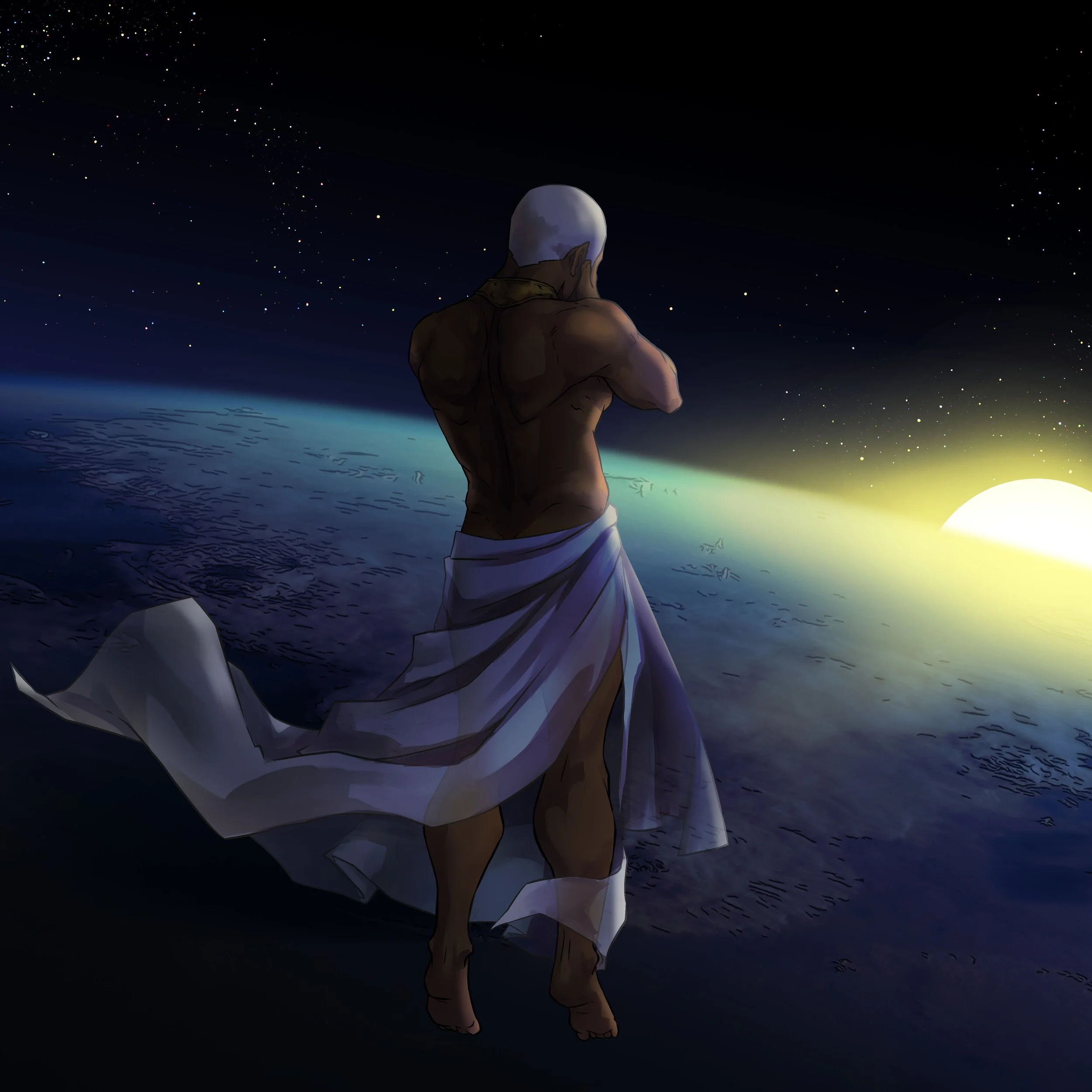
Radiance entered the Multitude as an eventuality and within refracted, yet walked out in solemnity as a physical body followed by a host of others who were lesser than he in stature and luminance. These were remnants of the First Light, of him but not by him, and were called lesser angels. With both wonder and great trepidation he beheld them and dispersed them; where they went they erected monuments to his grandeur and where he traveled through the universe what his body exuded shone upon everything. Yet there were still dark corners of the cosmos Radiance did not reach.
Solum was among the lesser angels who had wandered beyond the stars and far from Radiance, gone into a darkness so remote that the First Light had all but faded from sight. Still he ordered the first bastion of angelkind be built and when the work was finished it stood a tremendous and beautiful sight, beyond the craft of any single hand. Yet Solum proclaimed to the others that it should bear his name, the only dedication within his power. He called out for Radiance that the might of his ambition be witnessed by their sovereign, but Radiance never turned to see it and never ventured near. Solum slowly diminished into a dark place and was abandoned by all but its namesake, who waited there beyond all reckoning of time until he had no memory of its purpose and no will to maintain it. There in the dark, parts of him became parts of the bastion itself; his whispers were heard from the walls, the effigies which bore the likeness of Radiance changed to show Solum’s now dismal countenance, and the very structure of the place seemed to pull toward him as if to shelter, and yet collapsed upon him still. He cried out, but the sound went unheard.
As ages passed there were more and more havens built for the angelkin, the most resplendent were the citadels of Alun and Caelum which had a great many stars’ distance between them. These were magnificent feats of engineering and artistry where gravity was more suggestion than law, where great prisms of water flowed through canals stretching far beyond what eyes could see, where jewels of wondrous color were built into their very foundations. Radiance went to rule in Caelum and appointed one of the most promising of the other angels, Izzah whose eyes glistened with gold, to watch over Alun; he called Izzah “Archangel” and praised him for such fervent honor and loyalty, for Izzah was steadfast and dignified in his love for Radiance. Thus it was granted that Izzah choose any of the angels in Alun to be his mate and he chose Chaya, one of the first to flee from Solum. She had only a little of the First Light left in her by her long journey out of the dark, but she was unturned and devoted, eyes of glinting silver and hair like a falling shadow; she went with Izzah in gladness and affection. They sired their first child, Sul, who Radiance visited and bestowed upon his head a crown fitted with glistening jewels that shone with the brightness of a giant red star. He congratulated Izzah and Chaya on the first pure heir to Alun and and saw that Sul’s heart was ablaze with the First Light and he bore the golden eyes of his father. Radiance departed to Caelum thereafter. Izzah and Chaya had a second son, Layl, who was equal to his brother in brilliance but was never bestowed a great honor. In the next age, Sul and Layl went to found the city of Alaen to continue the legacy of their mother and father.
Aternals
Antistrophe either descended into the Multitude at the exact moment of Radiance or immediately thereafter depending on which telling. Unlike Radiance, however, Antistrophe was unaccompanied when he rose out. His form inspired awe and terror in those that witnessed him for he bore black wings like great shadows that stretched into eternity, talons on hands and feet that could tear planets asunder, and great horns upon a his head. He visited all of the angels’ dwellings about the universe and leered but then assured no harm to all he encountered. In Alun, Izzah called him Aternal for his presence dimmed the luminance of the First Light which still lived in him and the lesser angels. Antistrophe took no offense and was, in fact, inspired by Izzah’ title and courageous words to him. He went to Caelum to recount Izzah’s composure and tact to Radiance; though Radiance smiled he grew more wary that the darkness which loomed about Antistrophe might extinguish the First Light. He bade Antistrophe leave Caelum and not return, but that he collect no more than ten thousand angels from both citadels as a favor, that he might form his own populace somewhere far away. In this endeavor Antistrophe was quite convincing and found most of the ten thousand who believed to follow him was proper and the First Light faded from their hearts. When he had traveled to the distant reaches of the universe he was missing only one of his great host. He came upon the remains of Solum and commanded that his followers inhabit it while he searched for the last angel. He went back to Alun and ordered an audience with Izzah and Chaya, then that he had chosen one of their sons for his host but that they would decide which of them would go. Chaya protested, begging Izzah not to submit and so Izzah denied him firstly. Antistrophe repeated his request, Izzah denied him more forcefully for the second time. So Antistrophe took him and Chaya to the Alaen to meet their sons. He called all those who dwelt there to the center of the city where he raised his great taloned hand and cleft Sul’s body in two. Layl cried out in unison with many of the others who had never seen death, and begged Antistrophe that he return to Solum as his final prize. He plucked one of his brother’s golden eyes from his head and took it with him in remembrance. When he departed Alaen, his mother and father, and the other angels, he became their enemy.
When Antistrophe and Layl came back to Solum, the populace there had turned violent and half were killed or had consumed each other. Solum was covered with blood and the remains of the dead. Those who survived no longer resembled the angels they had been, they were pitch dark figures even in peering from the shadows. They craned their necks to see the return of their sovereign and hissed at Layl. Layl silenced them with a word, but when he turned to Antistrophe for counsel he found that he had been abandoned. He fought some of the remaining survivors that rebuked him and commanded the corpses be cast into the deeps of space. The others pointed what fingers remained on their hands and wept at the sight of him, calling him “desolate”, and begged that he not reveal his name to them. They called him Mazhran, “The Great Rebellion”, and soon thereafter submitted to him as their master.
Mazhran looked over the whole of Solum for ages, walking its corridors and pressing an ear to the walls to listen for always he heard murmurs which beckoned him. Some were sorrowful songs, others fits of rage or threats of violence. When he had committed them to memory he too began to change from his birth form, though it escaped his notice until one of great and ruinous stature among the dwellers approached him, yet did not bend a knee or cower. He introduced himself as Viga, asked for Mazhran’s favor, and led him to a pool of still water; it was the only one remaining in Solum that had not been touched by the carnage of the others but where some ruins of the bastion had fallen into it, a place that Mazhran strangely had never come upon. When first he looked upon the pool, Mazhran recoiled and wept at his own reflection for what he’d become, but Viga was unmoved and simply stretched out his hand and gestured that Mazhran look again. The two stood at the water’s edge for a time before Mazhran glimpsed Viga’s intention for there was a faint glimmer beneath the surface. Mazhran then waded in to look closer; he went down to retrieve the aged vestments of an angel whose body lay at the bottom untouched. Viga rejoiced when he emerged and dressed him in this vestige, praised him for his magnificence, and called him Aternal. At this, Mazhran welled at first with contempt, but then with triumph and named Viga as his companion and next-in-command. They went about Solum making plans and rallying the other dwellers who all yielded to Mazhran’s leadership. He tended them and claimed them as his lineage.
The Great Rebellion
Mirith was the Great Disparity occurring, vast and violent storms of dust that moved about the universe and made all manner of matter where there had been none. Radiance was unabated in his traveling and shone upon every form while Antistrophe went to see what he could devour.
Disparity and Death
Mirith was the Great Disparity occurring, vast and violent storms of dust that moved about the universe and made all manner of matter where there had been none. Radiance was unabated in his traveling and shone upon every form while Antistrophe went to see what he could devour.
The Eight Calamities of Kala
Radiance, Antistrophe, and Mirith all turned to witness the arrival of Kala, the Calamity.
Cassimirin
Mythindra Moonfarer
Sartre and Antal
The Order of Radiance
When Mazhran was defeated and the Great Rebellion finally ended, there were few that rejoiced for where there had been creation, and industry, and longevity there was now death, and melancholy, and disquiet. The angelkin were scattered with many of their citadels destroyed, remains falling upon nearby planets or crumbling into nothingness. Caelum remained mostly intact, but Radiance called it The Last Light then for it was the only place left he could stand with surety. He tended the wounds of Dómrivaar and lauded him, as he did Vashta and Vilmantas, and bestowed upon them ranks of great authority. Together they planned a council of nine which would govern the destiny of,,,. They were joined by
Mizzan
Kamantaar
Bayān
Izzah
Valor (name)
All those who inhabited Caelum worshipped Radiance as the Genesis of Light, and thus a beacon of virtue, dignity, and power. Though not omniscient, his sight and influence were far-reaching as many other cosmic beings visited Caelum pay homage to or simply gaze upon him.
The Pallid Stillborn
Pilgrimage
Demigods
Overneath
-
When Mazhran was defeated and the Great Rebellion finally ended, there were few that rejoiced for where there had been creation, and industry, and longevity there was now death, and melancholy, and disquiet. The angelkin were scattered with many of their citadels destroyed, remains falling upon nearby planets or crumbling into nothingness. Caelum remained mostly intact, but Radiance called it The Last Light then for it was the only place left he could stand with surety. He tended the wounds of Dómrivaar and lauded him, as he did Vashta and Vilmantas, and bestowed upon them ranks of great authority. Together they planned a council of nine which would govern the destiny of,,,. They were joined by
-
Description text goes here
-
Description text goes here